Did you know that manual umbrellas still account for two-thirds of all umbrellas sold in the United States? If you think that manually deployed umbrellas are a thing of the past, think again. According to data from IndexBox and Market Growth Reports, the total U.S. umbrella market moves over 142 million umbrellas annually, and within this massive volume, the manual umbrella remains the preferred choice on rainy days. It is the go-to option for smaller, portable profiles, proving that manual operation is here to stay for several very specific—and very practical—reasons.
Automatic Means Constant Tension
While marketing often pushes “one-click” gadgets, the savvy majority recognizes a fundamental truth: automatic umbrellas are spring-loaded, which means they are under constant internal tension when opened. Carrying one is less like holding a tool and more like carrying a jack-in-the-box that has already been wound up.
That internal tension is a constant stressor on the frame. Imagine holding a heavy door open against a powerful hydraulic closer for an hour; eventually, something is going to give. In an umbrella, that “something” is usually the internal catch or the spring itself. Because these systems rely on high-tension, heavy-gauge steel springs to force the canopy open, they are inherently prone to mechanical fatigue. When a spring fails under that kind of pressure, it doesn’t just stop working—it can snap or lose its “bite,” rendering the umbrella a liability rather than a shield.
Manual Means Safety, Compact and Control
The manual umbrella bypasses these “high-tension” risks entirely by focusing on four key pillars:
- Safety: Automatic umbrellas deploy with a violent “thwack” that can be genuinely dangerous in tight spaces. Manual operation allows for a graceful, controllable deployment tailored to your surroundings—essential for navigating crowded city sidewalks without startling a bystander.
- Failure Rates: Without a complex trigger and a loaded spring waiting to fail, manual umbrellas have significantly lower failure rates. There is no internal motor to jam and no spring to rust or snap. It is a reliable, “low-stress” mechanism.
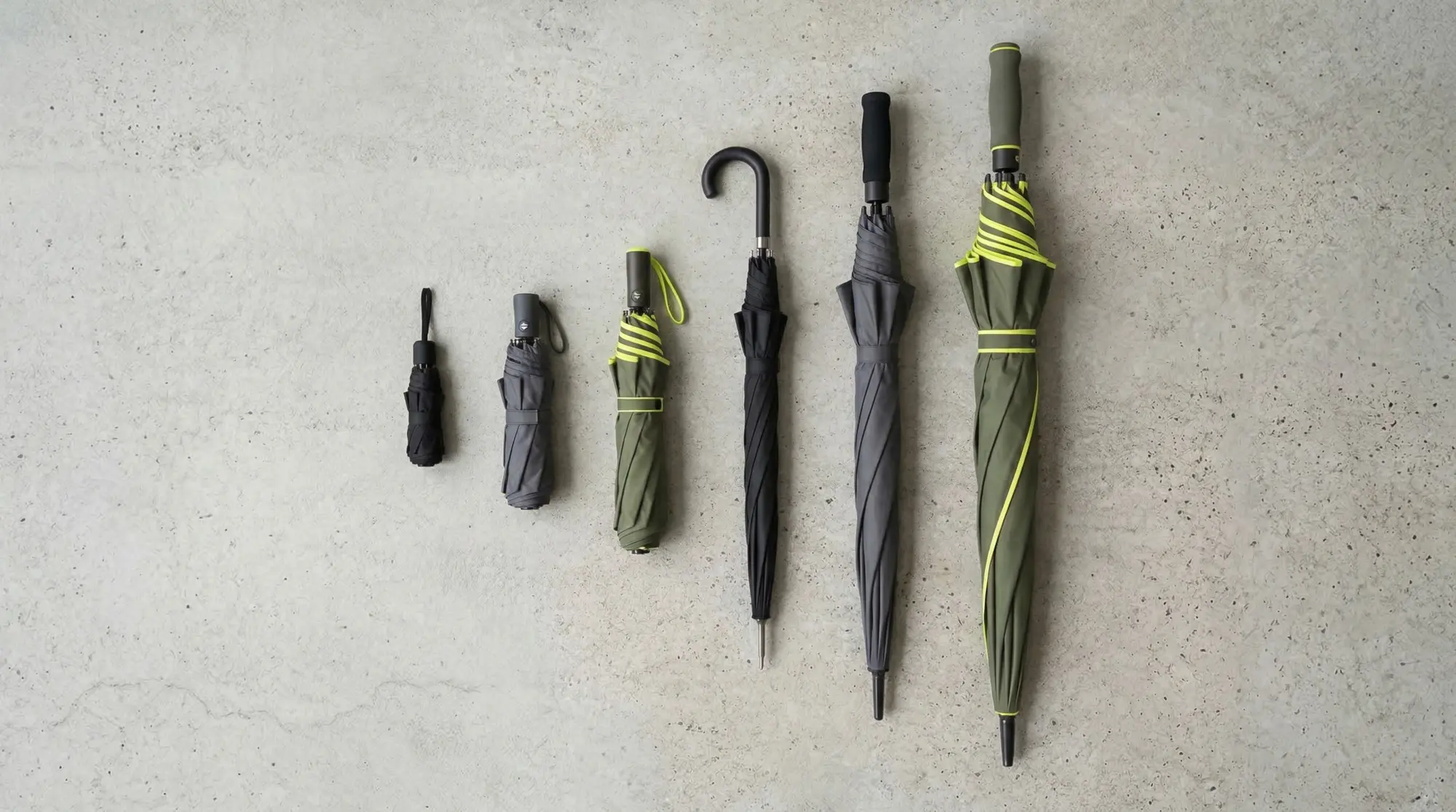
- Compactness: Engineering an automatic motor requires physical space. To house those heavy-gauge springs, the shaft must be thicker and the handle must be bulkier. Manual umbrellas achieve a much leaner profile, fitting into bags and pockets that an automatic simply cannot accommodate.
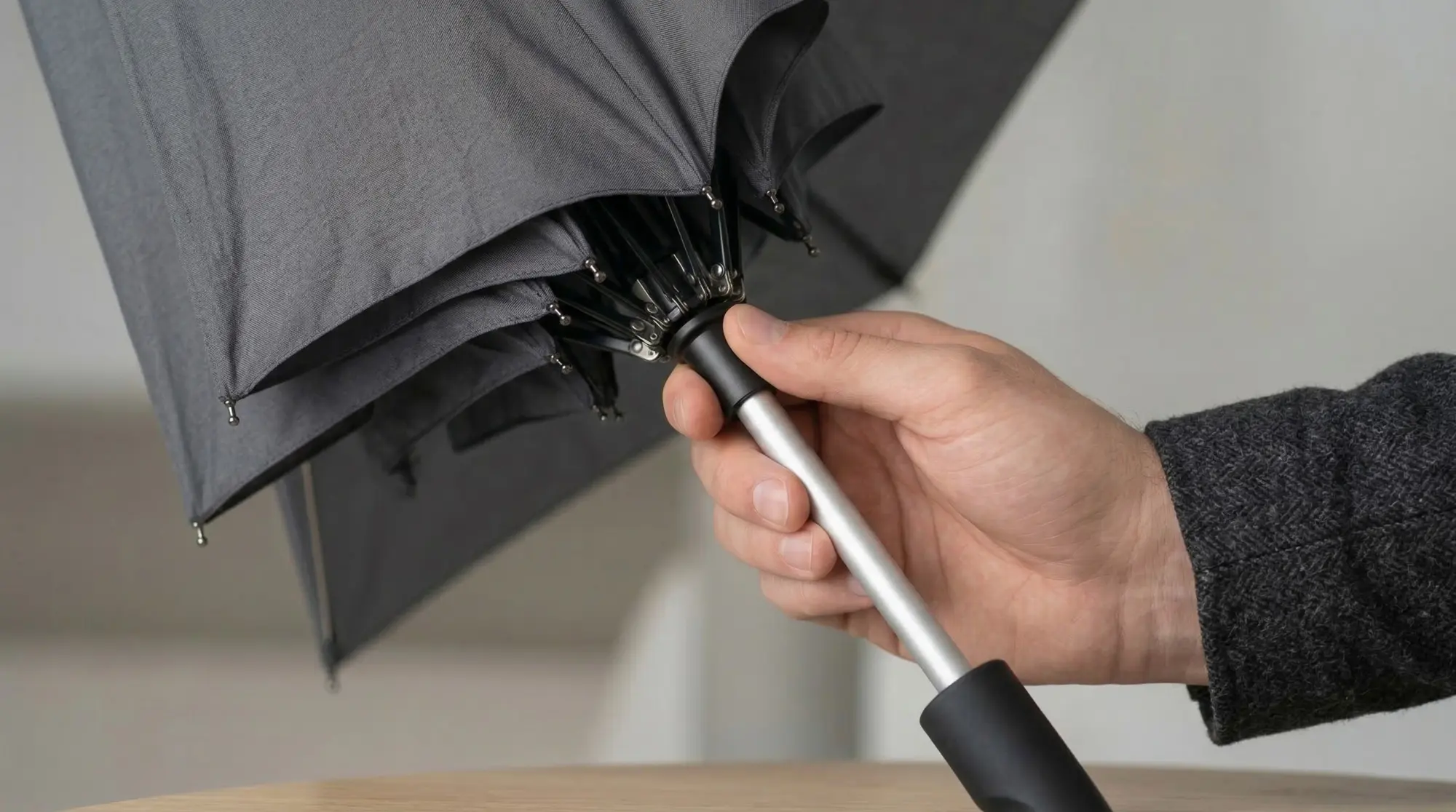
- The “Feel” of Control: There is a tactile security in a manual slide. You know exactly when the umbrella is locked, and you aren’t fighting a mechanism that wants to fight back.
The Expert Breakdown: Manual vs. Automatic
| Metric | Manual (The Specialist) | Automatic (The Gadget) |
| U.S. Annual Unit Sales | ~92 Million Units (65%) | ~50 Million Units (35%) |
| Mechanical Integrity | Low-stress; Slide & Lock | High-stress; Spring-loaded |
| Failure Risk | Extremely Low | High (Spring fatigue/Trigger jam) |
| Weight-to-Protection | Lightweight; Optimized for Portability | Heavier; Burdened by Internal Hardware |
| User Agency | Controllable slide speed; safe in crowds | Binary; high-force deployment |
| Longevity | Built for consistent, daily use | Limited by high-tension fatigue |
Reliability is the Ultimate Luxury
There is a quiet, witty sophistication in a manual tool done right. When you remove the unnecessary gadgetry, you are left with pure utility. This is why the world’s most discerning commuters still reach for a manual handle: they value a tool that works every single time, without the unpredictability of a spring-loaded device. In an era where “more features” often means “more ways to break,” the manual umbrella is a statement of common sense.
Our Flagship: The 46/11.5 System
We took this philosophy of control and engineered it to its peak. Our flagship 2 in 1 Rain Management System features a 46-inch manual canopy—the size of a stick umbrella—that collapses down to a mere 11.5 inches. This 4.0 expansion ratio is an engineering feat that is virtually impossible to achieve with a bulky, spring-loaded automatic mechanism.
But we didn’t stop at the umbrella. True rain management means the water stays where it belongs: outside. Our bundle includes a drip-proof, hands-Free carry bag with laboratory-grade leakproof lining. When you move into interior spaces with your wet umbrella in tow, it slides perfectly into its custom container, ensuring that rainwater never touches your clothes, your floor, or your tech. You don’t need a spring-loaded jack-in-the-box to tell the clouds who’s in charge. This low-stress system built for a high-stress world, prioritizes fail-proof craftsmanship over unpredictable gadgetry. So your umbrella-and your composure-won’t snap under pressure when caught in a storm.